
Kwh Cost Calculator
Find out what any appliance costs to run. Enter its power in watts, how many hours a day you use it and your electricity rate per kWh, and see the cost per hour, day, month and year. Add several devices to see which ones drive your bill.
- Free to use
- No sign-up
- Runs in your browser
Quick answer
Dishwasher electricity cost is usually best estimated from the yellow EnergyGuide label or measured kWh per cycle. Multiply kWh per load by your electricity rate, then by loads per month. For example, 1.0 kWh per cycle at $0.17/kWh costs $0.17 per load; 15 loads per month costs $2.55 before water, detergent and fixed utility charges.
Calculate electricity cost
Add up several appliances
| Appliance | Watts | Hours/day | kWh/month | $/month |
|---|
Home Energy Audit Workbook
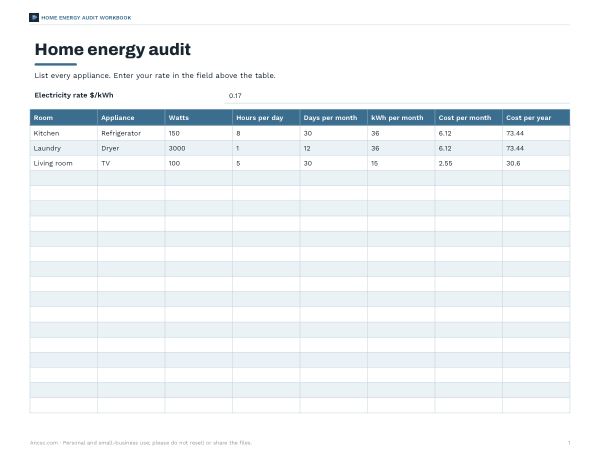
Audit every appliance in your home, see costs by room and category, track monthly meter readings and plan savings.
- Appliance audit workbook (XLSX, PDF)
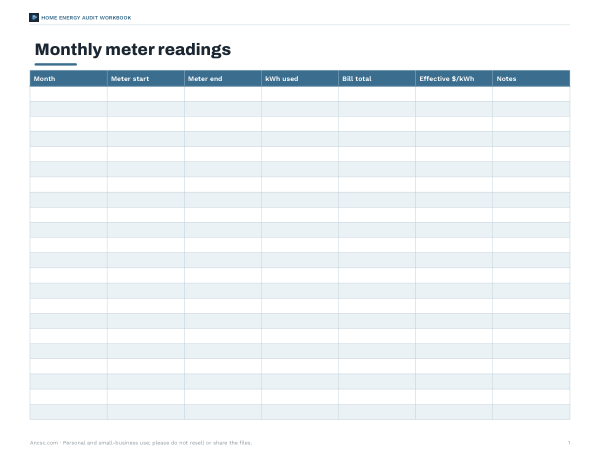
- Meter reading log (PDF, XLSX)
Formats: XLSX, PDF, DOCX. Instant download after payment (link valid 72 hours, up to 5 downloads). AI-assisted: the templates were drafted with AI help and reviewed and laid out before publishing.
$4.00 USD, one-time
- Instant download
- 7-day refund
- Secure checkout by Stripe
7-day money-back guarantee. Full refund within 7 days of purchase, even after you download.
Full refund within 7 days — see the refund policy and license.
Free printables
Single sheets you can print right now, no sign-up. The full pack adds every sheet in one download plus the editable files.
Dishwasher electricity cost examples
Examples use $0.17/kWh; replace it with your own electric rate in the calculator.
| kWh per cycle | 10 loads/mo | 15 loads/mo | 30 loads/mo | 215 loads/yr |
|---|---|---|---|---|
| 1.0 kWh | $1.70 | $2.55 | $5.10 | $36.55 |
| 1.2 kWh | $2.04 | $3.06 | $6.12 | $43.86 |
| 1.5 kWh | $2.55 | $3.83 | $7.65 | $54.83 |
| 2.0 kWh | $3.40 | $5.10 | $10.20 | $73.10 |
How electricity cost is calculated
Your utility charges for energy in kilowatt-hours (kWh). A kilowatt-hour is the energy used by a 1,000-watt device running for one hour. To find the cost of running an appliance:
- Convert watts to kilowatts: watts ÷ 1,000.
- Multiply by hours of use to get kWh.
- Multiply kWh by your price per kWh.
A 1,500-watt space heater running for 3 hours uses 1.5 × 3 = 4.5 kWh. At $0.17 per kWh, that is about $0.77 a day, or about $23 a month if used every day.
Finding your appliance's wattage
- Look for a label on the back or bottom of the appliance, or on its power adapter: it may list watts (W), or volts (V) and amps (A) — multiply volts × amps for approximate watts.
- Check the manual or the manufacturer's website.
- For refrigerators, water heaters and dishwashers, the yellow EnergyGuide label in the US gives estimated yearly kWh directly.
- A plug-in energy monitor measures real consumption over days, which is the most accurate for devices that cycle on and off.
Duty cycle: appliances that switch on and off
Many appliances do not run at full power the whole time. A refrigerator's compressor cycles on and off; a thermostat-controlled heater or air conditioner runs harder on extreme days; a dryer's heater cycles as it reaches temperature. The duty-cycle field lets you account for this: if a 150-watt fridge compressor runs about a third of the time, enter 33% with 24 hours a day. When in doubt, a plug-in meter or the EnergyGuide yearly kWh figure gives the most realistic number.
What is your electricity rate?
Your bill shows the price per kWh, often split into supply (generation) and delivery charges plus taxes. For a simple estimate, divide the total of your bill's energy-related charges by the kWh used that month. Rates vary widely by location and season; many US households pay somewhere between about 12 and 30 cents per kWh. If you have time-of-use pricing, use the rate for the hours when the appliance actually runs.
Typical appliance wattages
| Appliance | Typical watts | Notes |
|---|---|---|
| LED bulb | 8–12 W | Replaces a 60 W incandescent |
| Laptop | 30–70 W | Less when idle |
| 55-inch LED TV | 60–120 W | Varies by brightness |
| Refrigerator | 100–250 W running | Cycles; ~300–700 kWh/year |
| Microwave | 900–1,200 W | Short use |
| Space heater | 1,500 W | Common maximum for plug-in heaters |
| Clothes dryer (electric) | 2,000–5,000 W | Major user |
| Electric water heater | 3,000–5,500 W | Often the largest single user |
| Central air conditioner | 2,000–5,000 W | Depends on size and efficiency |
| EV Level 2 charger | 3,000–11,000 W | Charging time depends on battery |
Worked example: which device drives the bill?
The multi-appliance table starts with a refrigerator averaging 150 W for 8 hours of compressor time a day (36 kWh a month), a TV at 100 W for 5 hours (15 kWh), and an electric water heater at 4,000 W for 3 hours (360 kWh). At $0.17 per kWh, the water heater costs about $61 a month — around 88% of the total — while the TV costs about $2.55. Heating and cooling appliances almost always dominate, which is where savings efforts pay off most.
Ways to cut the cost
- Lower the water heater temperature to around 120 °F (49 °C) and fix dripping hot taps.
- Use heating and cooling setbacks when away or asleep.
- Air-dry laundry or run full dryer loads with clean lint filters.
- Replace remaining incandescent bulbs with LEDs.
- Unplug or switch off devices with high standby use, such as older set-top boxes and chargers.
- Shift flexible loads such as dishwashers and EV charging to off-peak hours if you have time-of-use rates.
Standby power
Many electronics draw a small amount of power even when switched off or idle — often called standby, vampire or phantom load. Individually it may be only a few watts, but across a household of devices it can add up to a noticeable share of consumption. A device drawing 5 W continuously uses about 44 kWh a year. Smart power strips that cut power to peripherals when the main device is off, and switching off at the wall, reduce this waste.
Frequently asked questions
How do I use the calculator for a dishwasher?
Use the dishwasher’s EnergyGuide kWh per year if available, or enter the measured kWh per cycle as watts and hours equivalent. For a monthly estimate, multiply cost per cycle by the number of loads you run each month.
Does heated dry change dishwasher electricity cost?
Yes. Heated dry uses extra electricity, so air-dry or no-heat dry settings usually lower the cost per load.
Can I calculate dishwasher cost from kWh per year?
Yes. Multiply the label’s yearly kWh by your $/kWh rate to estimate annual electricity cost, then divide by 12 for a monthly average.
How do I calculate kWh from watts?
kWh = watts × hours ÷ 1,000.
How much does it cost to run a 1,500 W heater?
At $0.17/kWh, about $0.26 per hour.
What is a kilowatt-hour?
The energy used by a 1,000-watt appliance running for one hour.
How do I find my electricity rate?
Check your bill for the price per kWh, or divide total energy charges by kWh used.
Why is my bill higher than the calculator total?
Bills include fixed customer charges, taxes and appliances you may not have listed, especially heating and cooling.
What is standby power?
Power drawn by devices when off or idle; small per device but it adds up over a year.
Does running an appliance at night cost less?
Only if you are on a time-of-use or off-peak tariff. With a flat rate, a kWh costs the same at any hour.
How accurate is the estimate?
It is as accurate as the wattage and hours you enter. Appliances that cycle or vary their power are best measured with a plug-in energy monitor.